
Sunshine in a Bottle: Your Winter (and Summer!) Guide to Vitamin D
Although there is a lot written about vitamin D supplementation in the media nowadays, there are still several misconceptions about why we need to take it, how much we should be taking, and how long for. It is often recommended that we only need to supplement vitamin D from October to March/April because during the remainder of the year in the UK we can synthesise vitamin D ourselves, however it’s not quite as straightforward that. Please read on…..
If you are interested in the reading the full article it can be found below however if you would like the main takeaway points only, they are here:
- Everyone in the UK should be taking vitamin D from October to April and possibly longer
- To know how much vitamin D to supplement we should be testing our vitamin D blood levels, either via our GP or privately, as a minimum once in October, ideally again in February and possibly again in the summer
- Research has indicated that a standard dose (not personalised through testing) of around 20,000iu weekly or 3,000iu daily could be sufficient for many people although there are huge variations in how much each person needs
- The GrassrootsHealth Nutrients Research Institute recommends an optimal serum level of 100-150 nmol/l
- Vitamin D is synthesised by the action of ultraviolet B (UVB) light rays, on our skin
- UVB light is most prevalent in the middle of the day when the sun is at its highest point in the sky, at other times of the day our ability to make vitamin D is likely to be decreased
- As a general rule if the length of your shadow is shorter than your height you should be able to synthesise vitamin D and conversely if your shadow is longer than the length of your body then the sun’s intensity will not be enough to synthesise vitamin D
- Anyone wearing sunscreen all the time or who is not outside often during the middle of the day in summertime may benefit from supplementing vitamin D during the summer months too, although potentially at a lower dose unless you are never out in the sunshine
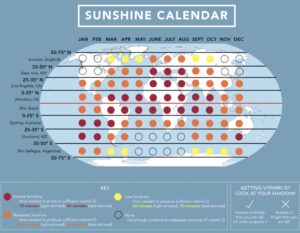
- The image below gives a good indication of our likelihood of synthesising vitamin D depending on where we are in the world
What Role does Vitamin D Play in our Health?
Immune Support: Vitamin D is a cornerstone of a healthy immune system, enhancing our body’s ability to fight off infections and diseases. Research during the pandemic showed that the people who were hardest hit by COVID infection generally had the lowest vitamin D levels (1) Many studies have also demonstrated a link between cancer and low vitamin D levels (2). Research such as this is demonstrating a link between the vitamin and disease, but there are many factors leading to ill-health in addition to vitamin and mineral status. But it surely is no coincidence that the cold and flu season occurs in the darkest and coldest part of the year when our vitamin D levels are more likely to be lower than optimal.
Mood and Mental Health: Lower vitamin D levels are linked to higher levels of depression and lower mood., A study in Norway tested volunteers for depression and blood levels of vitamin D. The volunteers were then given either Vitamin D supplements or a placebo. One year later, those given vitamin D, but not those given the placebo, had substantially lower depression ratings (3
Energy and Sleep: Vitamin D receptors are found in most cells; therefore, it plays a role in insulin balance, mitochondrial function, and sleep quality, all of these impact energy
Bone and Muscle Health: Vitamin D is essential for the absorption of calcium, which is vital for maintaining healthy bones and muscles, reducing the risk of fractures and osteoporosis.
Brain and memory: Vitamin D deficiency increases the risk of dementia and Alzheimer’s. One study in France followed a group of elderly people for 12 years; it found that those with low vitamin D levels had a nearly three-fold increased risk of Alzheimer’s (4).
What is Vitamin D?
Did you know that vitamin D is classified as a hormone? Unlike most other vitamins that must be obtained from the diet, vitamin D is synthesized by the body when our skin is exposed to ultraviolet B (UVB) rays. Cholecalciferol, or vitamin D3, is a prohormone and it is this chemical that is synthesised in the skin and is the most common form of vitamin D in supplements.
Cholecalciferol must be converted into the active hormone through a 2-stage process which occurs firstly in the liver, this is called calcifediol which is the primary circulating form of vitamin D and is what is measured when you have a blood test. The second conversion occurs in the kidneys to calcitriol which is the final biologically active form, and this is tightly regulated by parathyroid hormone (PTH) and blood levels of calcium and phosphate.
There are a couple of other nutrients that are often linked with vitamin D, the first is vitamin K2 which works with vitamin D to ensure proper calcium deposition in bones and teeth. The second is magnesium which is important for several reasons:
- Magnesium is a cofactor in both the liver and kidney enzyme processes
- Magnesium is involved in the activation of PTH, needed for the binding of vitamin D to its transport protein and as an antagonist to calcium
- Magnesium works synergistically to ensure proper calcium metabolism.
In my experience magnesium is another nutrient many people are deficient in, and it will be the focus of a future article.
Why is it Important to Check our Vitamin D Levels?
It’s a good idea to check your vitamin D levels ideally every few months but as a minimum at the start of each winter, if you haven’t done this yet it’s not too late! Either ask your GP for a test or else do an at-home finger-prick test which are available from several companies in the UK for £35- 40. Once you know your current Vitamin D levels, supplementation can be tailored to your specific needs as there is a formula for calculating how much you need to bring up your blood levels to optimal levels which can be found here: https://www.grassrootshealth.net/project/dcalculator/
Supplementation: How Much is Enough?
Vitamin D is a fat-soluble vitamin which is stored in the body; therefore, you can take a weekly dose rather than daily. The official marker for “sufficient vitamin D” is 50 nmol/l (nanomoles per litre) However, as a nutrition practitioner I am looking a minimum blood level of 75nmol/l but ideally above 100 nmol/l .
Vitamin D supplements are sold in international units (iu) or micrograms (mcg orμg), the interchangeability of these units can make comparing different products quite confusing as some manufacturers use iu and others use mcg/μg. The conversion is quite simple as 40iu equals 1μg and many supplements use these amounts:
- 400iu or 10μg is commonly found in children’s products
- 1000iu/25μg is generally the standard dose for adult products
- there are higher strength products with 3000iu/75μg or 4000iu /100μg.
The UK RDA (Recommended Daily Allowance) for vitamin D is set at a very conservative 400iu/10 μg. This is the amount most people would need to prevent rickets, a bone disorder from vitamin D deficiency and it assumes your blood level of vitamin D level is already sufficient. However, there is a difference between the minimum needed to prevent a disease and the amount to needed for optimal health. If your vitamin D levels are low, supplementing with 400iu or even 1000iu is unlikely to make any significant difference to your blood levels.
In the Norwegian mood study referenced above they gave 20,000iu or 40,000iu weekly. Participants given 20,000iu averaged a blood level of 88 nmol/l, while those given 40,000iu averaged 111nmol/l. In summary both dosages worked and there wasn’t a significant difference in mood between the two groups. On this basis it is reasonable to assume that around 20,000iu weekly or 3,000iu daily should be sufficient for many people, however the ideal is to test and retest after 3 months to monitor your levels.
What Type of Vitamin D should we Supplement?
As I mentioned above most supplements are in the D3 (cholecalciferol) form, which is what the skin synthesises from sunlight. I would recommend this rather than D2, ergocalciferol which is a precursor to D3 and not as biologically active. There is one company that is now selling a calcifediol supplement, this requires less processing to become the active version of calcitriol. I have no experience of this product at the time of writing, but it may increase blood levels of vitamin D much quicker than D3.
Another complication is how the vitamin is presented: capsules, tablets, sprays, liquid and chewable. As vitamin D is fat soluble, I have found emulsified vitamin D drops, which can be taken sub-lingually, to be both easy to take and very effective at bringing blood levels up to optimal levels. It is also great for children as there are no capsules to swallow and they often need only one or two drops so it can be taken directly or hidden in something. If you don’t fancy the emulsified liquid, then high strength capsules from a reputable company would be the next best option.
Are there Food Sources of Vitamin D?
Although supplementation is crucial for those living in the UK and Northern Europe during the winter, incorporating natural Vitamin D-rich foods to your diet can offer an extra boost, although not enough to rely solely on food sources.
Vitamin D is most prevalent in animal foods such as:
- Oily Fish: Salmon, mackerel, and sardines are excellent sources of Vitamin D, but all fish contain some
- Red meat and liver contain some vitamin D but at much lower levels than oily fish
- Egg Yolks contain some vitamin D
The main plant-based source which is important for vegetarians and vegans are mushrooms although it is mainly in the D2 or D4 pro-vitamin form rather than D3. Certain varieties, like maitake and chanterelles, often have higher levels than the humble white mushroom but all should naturally contain some Vitamin D. And did you know that you can increase the vitamin D content of mushrooms by leaving them outside in the sunlight – this was new information to me!
Do we make enough Vitamin D in Summertime?
The amount of vitamin D you can synthesise from April to September will depend on several factors including your genetic makeup (some people are not as efficient at making vitamin D), when and how long you are outdoors for, how much of your body is exposed to the sun, if you have used a sunscreen (which prevents vitamin D synthesis), the colour of your skin, your weight and where you live (Southern England receives more UVB rays than the far north of Scotland due to latitude difference).
How much time you need to spend outdoors in summer to synthesise sufficient vitamin D will depend on the above factors. UVB rays are most prevalent when the sun is at its highest point in the sky, in the hours around midday, as the angle of the sun decreases so does the amount of UVB radiation, which is why we can’t make much vitamin D in the winter. In addition, cloud cover, pollution and ozone levels all have an impact on how much of the UVB radiation makes it through to ground level.
The Vitamin D Council estimates that a fair-skinned person may be able to synthesise 10,000 – 25.000iu in 30 minutes, people with darker skins may need 3-5 times more exposure to generate the same levels. Even if you spend a significant amount of time outdoors in the summer, if you wear sunscreen or are not outside in the middle of the day you may not make as much vitamin D as you thought you were! I must admit I had always been under the impression that for most people our vitamin D levels were likely to be sufficient during the summer but having researched this subject I’ve come to a different conclusion.
I am aware that exposing your skin to the sun without sunscreen in the middle of the day goes against all the advice we are given by the media and government, if you wish to obtain vitamin D from sunshine this obviously needs to be balanced with protecting your skin from sun damage or burning. From my research for the purposes of vitamin D synthesis, the goal is to expose your skin until just before it starts to go pink, how long this takes will vary between individuals; in addition, the more of your body you have exposed the greater surface area for the skin to synthesise vitamin D. Regular, shorter sessions of sun exposure may be preferable to longer sessions which risk damaging the skin. This is a different topic which I won’t expand on here, but sunlight is vital for much more than vitamin D synthesis including managing our circadian rhythm.
In summary my recommendation is that in the UK we should all be supplementing through the winter with approximately 3000iu a day and it may be beneficial for most people to continue to supplement during the summer but at a lower level. As we are all individual and as I have explained there are multiple factors affecting our ability to synthesise vitamin D I also recommend getting your vitamin D levels checked every few months so that you can supplement with an appropriate dose for you. If you are on medication or have any pre-existing health conditions, it is a good idea to check with your GP or healthcare provider before taking high dose vitamins or minerals.
References
1 Vitamin D Insufficiency May Account for Almost Nine of Ten COVID-19 Deaths: Time to Act. Comment on: “Vitamin D Deficiency and Outcome of COVID-19 Patients”. Nutrients2020, 12, 2757
2 Carsten Carlberg a, Eunike Velleuer b Vitamin D and the risk for cancer: A molecular analysis https://www.sciencedirect.com/journal/biochemical-pharmacology
3 Jorde R, Sneve M, Figenschau Y, Svartberg J, Waterloo K. Effects of vitamin D supplementation on symptoms of depression in overweight and obese subjects: randomized double-blind trial. J Intern Med. 2008 Dec;264(6):599-609. doi: 10.1111/j.1365-2796.2008.02008.x. Epub 2008 Sep 10. PMID: 18793245.
4 Jia J, Hu J, Huo X, Miao R, Zhang Y, Ma F. Effects of vitamin D supplementation on cognitive function and blood Aβ-related biomarkers in older adults with Alzheimer’s disease: a randomised, double-blind, placebo-controlled trial. J Neurol Neurosurg Psychiatry. 2019 Dec;90(12):1347-1352. doi: 10.1136/jnnp-2018-320199. Epub 2019 Jul 11. PMID: 31296588.